1 / 2
The Mohs hardness is ≥ 9.5, second only to diamond, significantly better than metal and oxide ceramics (such as zirconia and alumina), and the wear rate is extremely low under extreme friction conditions.
It can withstand compressive stress of >2.5 GPa, and is not easy to deform or shatter in high-speed and high-pressure environments.
Withstand >1600°C in inert atmosphere and stable up to 1400°C in oxidizing atmosphere, far exceeding metal bearing materials.
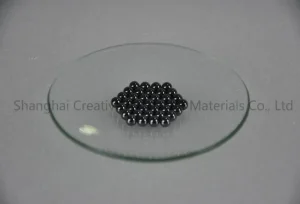
Resistant to strong acids (except hydrofluoric acid), strong alkalis, molten metals and highly corrosive media, and the life is more than 10 times that of stainless steel balls.
Efficient heat transfer, combined with designs such as dorsal helium cooling, ensures wafer surface temperature uniformity meets advanced process requirements.
Conductive/insulating types can be customized to meet the needs of static sensitive scenarios.
Resistant to high-energy particle irradiation, suitable for nuclear industry and space equipment.
The material features ultra-high hardness with a Mohs hardness of ≥ 9.5, which is second only to diamond and significantly outperforms metals and traditional oxide ceramics like alumina and zirconia.
It offers high compressive strength, capable of withstanding compressive stress greater than 2.5 GPa without easy deformation or shattering in high-speed, high-pressure environments.
It can withstand temperatures exceeding 1600°C in inert atmospheres and remains stable up to 1400°C in oxidizing atmospheres, far surpassing metal-based alternatives.
It is chemically inert and highly resistant to strong acids (excluding hydrofluoric acid), strong alkalis, molten metals, and other highly corrosive media, lasting more than 10 times longer than stainless steel balls.
Yes. The semiconductor characteristics of the material can be customized into conductive or insulating types to meet the requirements of static-sensitive operating scenarios.
Yes, thanks to its high radiation resistance against high-energy particle irradiation, it is well-suited for use in both nuclear industry and aerospace equipment.