1 / 3

The Mohs hardness of silicon carbide is as high as 9.2-9.3, and its microhardness is much higher than that of cemented carbide and alumina ceramics. This makes the nozzle effectively resistant to direct scouring and cutting wear of high-speed particles such as emery, glass beads, steel shots, etc.
Under the same working conditions, its wear life is more than 10 times that of tungsten steel (cemented carbide) nozzles and 5-8 times that of alumina ceramic nozzles, which is close to the level of hot-pressed boron carbide nozzles. The frequency of downtime and replacement is greatly reduced, the production efficiency is improved, and the comprehensive cost of use is reduced.
Silicon carbide is a compound with extremely strong covalent bonds and extremely stable chemical properties. It does not react with any known acid, alkali and salt solutions at room temperature, and can withstand the erosion of strong acids, strong alkali and various corrosive solvents for a long time.
This property makes it particularly good in strong corrosion conditions such as wet sandblasting in the chemical industry, chemical spraying in wastewater treatment plants, and lime slurry injection in flue gas desulfurization (FGD), without structural damage or performance degradation due to chemical corrosion.
Through precisely controlled sintering aids and processes, our pressureless sintered silicon carbide achieves a density close to theoretical values (>98%), with a uniform structure and no internal defects, ensuring consistent performance.
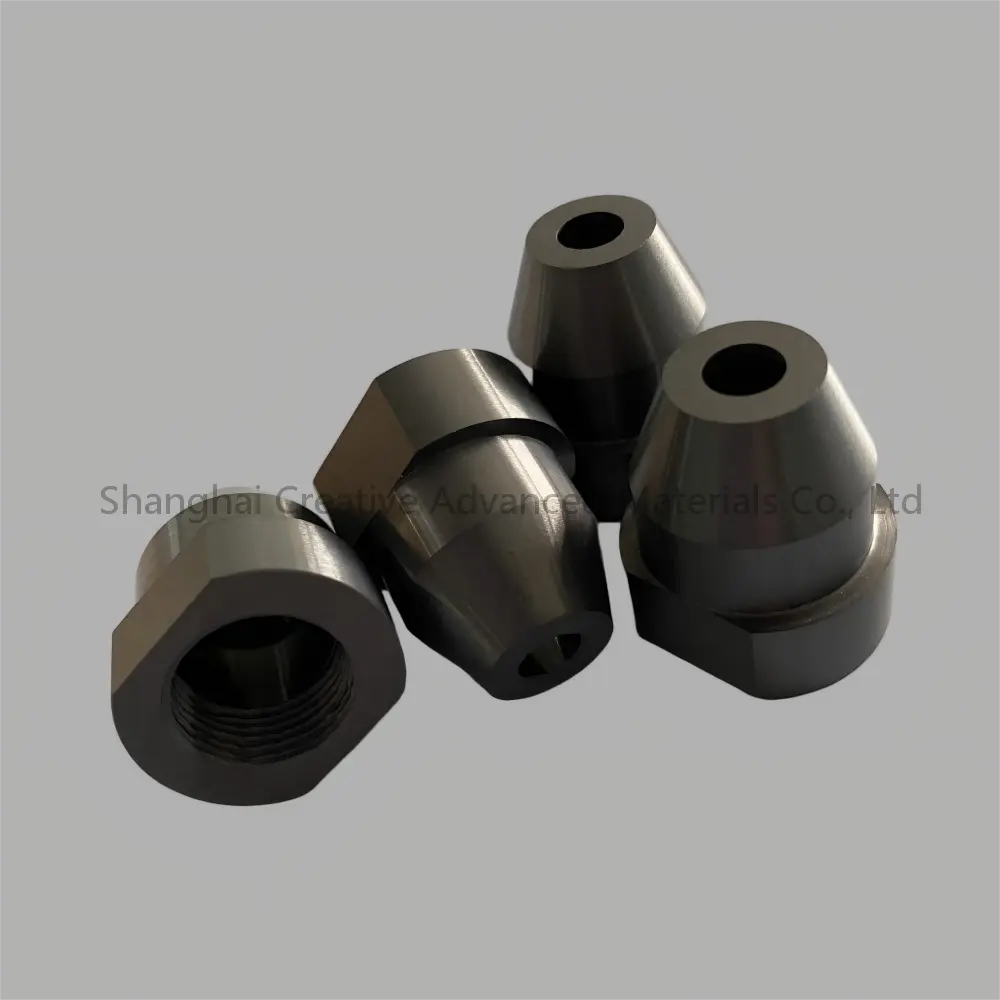
Compared with hot press sintering, the pressureless sintering process is easier to prepare nozzle products with complex shapes and larger sizes, meeting the diverse needs of customers.
The Mohs hardness of silicon carbide is as high as 9.2-9.3, providing a microhardness that is significantly higher than that of cemented carbide and alumina ceramics, ensuring exceptional resistance to abrasive particles.
Under identical working conditions, the wear life of silicon carbide nozzles is more than 10 times longer than tungsten steel (cemented carbide) nozzles and 5 to 8 times longer than alumina ceramic nozzles.
Yes, silicon carbide has extremely stable chemical properties and does not react with any known acid, alkali, or salt solutions at room temperature, making it ideal for corrosive environments like wet sandblasting and wastewater chemical spraying.
The pressureless sintering process achieves a high density close to theoretical values (greater than 98%), creating a uniform internal structure free from defects for consistent mechanical performance.
It avoids the high equipment and tooling costs associated with hot-pressing molds, offering a much more competitive price while delivering performance close to hot-pressed boron carbide.
Yes, compared to hot press sintering, the pressureless sintering process makes it significantly easier to manufacture nozzle products with complex shapes and larger dimensions to meet diverse customer specifications.