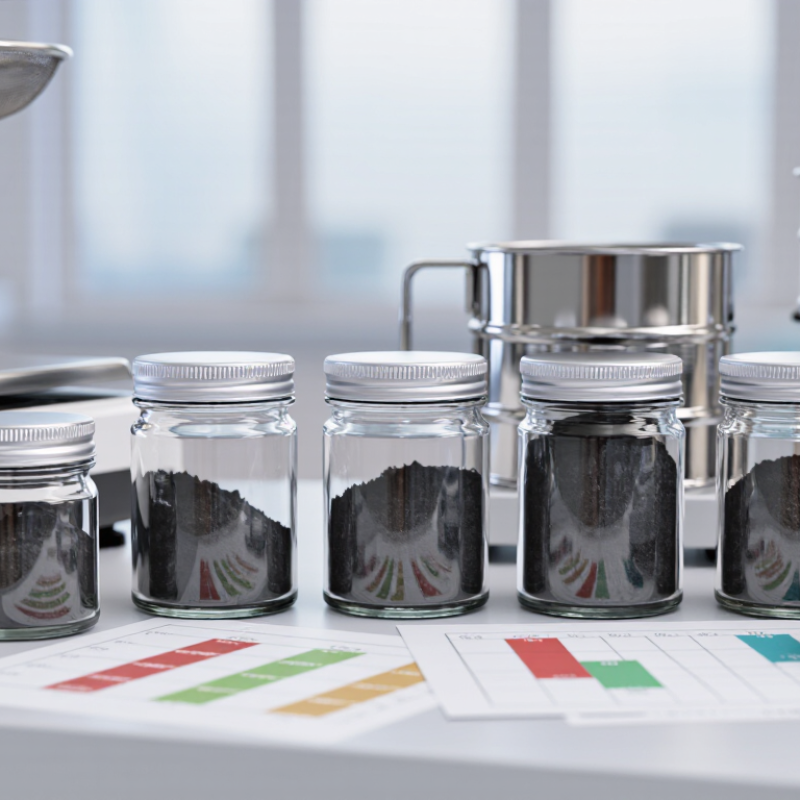
China’s B4c Boron Carbide market deserves a closer look than a supplier list alone. Buyers need to compare purity, particle size, density, and production consistency. These details can change both performance and price. A fine black powder may look identical across two sample jars. Its test certificate may tell a different story.
The USGS Mineral Commodity Summaries 2025 tracks boron-bearing minerals, but it does not provide a standard price series for finished boron carbide. That distinction matters. Boron carbide is a processed material, and supplier quotations depend on grade, order volume, processing, and delivery terms. NIST’s technical report Material Properties of Boron Carbide, by materials scientist Robert G. Munro, offers a useful basis for evaluating specifications. In paraphrase, Munro’s work reminds buyers to assess measured material properties and test conditions, not rely on a grade label alone. Verify the details.
This guide examines prominent Chinese manufacturers, typical quotation factors, and practical questions to ask before requesting samples. It will distinguish public market information from supplier claims, since published prices are often incomplete or not directly comparable. That limitation is real. A low quoted price means little without matching purity, particle size, and test methods. For procurement teams, the clearest comparison starts with a written specification and a recent certificate of analysis.
Boron carbide (B4C) is a lightweight ceramic made from boron and carbon. It ranks among the hardest known materials. A peer-reviewed review by Domnich and colleagues in the Journal of the American Ceramic Society reports a density near 2.52 g/cm³ and Vickers hardness commonly around 30–38 GPa, depending on testing conditions. Very hard. These properties help explain its use in abrasive tools and wear-resistant components.
Its low density matters when heavy parts must stay manageable. Its hardness helps resist scratching and abrasion, but it does not make the material unbreakable; impact can cause chipping. Boron-10 also absorbs neutrons effectively. NIST neutron data gives boron-10 a thermal-neutron absorption cross section of about 3,837 barns. This supports its use in neutron-absorbing components. Performance still depends on composition, grain structure, and manufacturing quality—not just a hardness figure.
Tips: Ask suppliers for a current technical data sheet, test method, and batch-specific density. Compare those details before comparing prices. A high hardness value alone does not predict service life.
Boron carbide in China is commonly produced by carbothermal reduction. Manufacturers blend boron oxide or boric acid with a carbon source, often petroleum coke. The mixture must be evenly prepared. Small differences in particle size can affect the reaction and the final powder.
The blend is heated in an electric furnace at very high temperatures, often above 2,000°C. Carbon removes oxygen from the boron compound, forming boron carbide and carbon monoxide. Furnace temperature, atmosphere, and holding time need close control. This step is less tidy than diagrams suggest: uneven heating can leave unreacted material. There is no single recipe for every plant.
After cooling, workers crush and mill the hard furnace product. It may then be washed or otherwise refined to reduce residual impurities, before screening separates particle sizes. Quality checks can include chemical composition, grain size, and density, depending on the intended use. Buyers should request test data for the specific grade, since production routes and acceptance limits vary. Careful processing matters. Even a clean-looking powder may differ in purity or grain distribution.
Chinese boron carbide supply comes from manufacturers focused on abrasive grains, ceramic powders, and advanced technical ceramics. Some produce B4C in-house; others process or distribute material from partner plants. Their product ranges may include coarse grains for abrasive use and fine powders for sintering or specialist components. Specifications vary.
When comparing suppliers, ask for the production site, available particle-size ranges, boron carbide purity, and limits for free carbon and oxygen. Request a recent certificate of analysis and a sample from the same production grade you plan to buy. A clear sieve analysis matters: two powders with similar labels can behave differently during mixing or sintering.
Price depends on purity, particle size, order volume, and packaging, so a headline quote alone tells little. Check whether the quoted grade is actually made at the stated facility, and ask how batches are tested. This step can feel tedious. It is still useful. Some suppliers may be trading companies rather than producers, and neither role is automatically a problem; the key is traceable documentation, stable supply, and honest answers when specifications need clarification.
Chinese suppliers commonly offer boron carbide as abrasive grains, fine powder, and sintering-grade powder. Typical commercial purity ranges from about 95% to 99% B₄C, with particle sizes spanning coarse grit to a few micrometres. Buyers should request the full size distribution, not just a “fine” or “micron” label. That label can mislead. Ask for total boron and carbon, free carbon, oxygen, iron, and other metallic impurities, plus the test method used.
The USGS Mineral Commodity Summaries 2024 reports global boron production at roughly 5 million metric tons, expressed as contained boron; this figure covers boron production, not B₄C powder. It helps explain why raw-material statistics cannot verify a powder grade. For purchasing, compare certificates of analysis and lot-to-lot limits. Abrasive grades may prioritize grit consistency, while sintering powders need tighter control of chemistry and particle size. Some specifications omit oxygen or report only a typical value. That deserves follow-up. Ask suppliers to state whether figures are guaranteed limits or averages, and confirm packaging, moisture limits, and sampling procedures before comparing prices.
Typical supplier-listed boron carbide purity ranges by application. Specifications vary by supplier and particle size; confirm them against the product datasheet.
Pricing: There is no single comparable price for each grade. Quotes depend on purity, particle-size distribution, order quantity, and packaging; request a current quotation with the required specification.
China Top B4C Boron Carbide Manufacturers and Prices?
Boron carbide prices in China vary because the product is not a single standard grade. Purity, particle size, and production yield strongly influence the quotation. High-purity B4C requires carefully controlled raw materials, stable furnace temperatures, and additional screening. A small change in carbon content can affect hardness and application performance. It can also increase processing costs.
Energy consumption is another major factor. B4C production uses high-temperature electric furnaces, so electricity prices and furnace efficiency matter. Raw material costs, especially boric acid and petroleum coke, also move with market conditions. Larger orders usually receive lower prices because manufacturers can spread setup and packing costs. However, unusually low offers deserve careful review. They may exclude testing, export packaging, or consistent particle grading.
From practical sourcing experience, buyers should compare complete specifications rather than unit prices alone. Ask for purity data, size distribution, moisture levels, test methods, and batch consistency. Packaging details matter too. A damaged twenty-five-kilogram bag can create dust loss and handling problems during transport. Freight rates, exchange rates, payment terms, and delivery distance further change the final cost. Supplier capacity and quality-control records provide useful evidence of reliability. Still, laboratory reports are not perfect. Independent testing may reveal differences between a sample and a later shipment, so regular batch checks remain sensible.
| Boron Carbide Category | Typical B₄C Content | Typical Particle Size | Indicative China Price (USD/Metric Ton) |
Common Applications | Main Price Factors |
|---|---|---|---|---|---|
| Standard Abrasive Grade | ≥95% | F4–F120 or equivalent mesh sizes | 2,500–5,500 | Grinding wheels, abrasive blasting, lapping and polishing | Purity, grain distribution, magnetic impurities, production volume and packaging |
| High-Purity Fine Powder | ≥97–98% | 1–10 μm | 4,500–9,000 | Advanced ceramics, wear-resistant components and precision finishing | Chemical purity, oxygen and iron content, milling technology and particle-size control |
| Ceramic and Armor Grade | ≥97% | Submicron to several micrometers | 6,000–12,000 | Body armor ceramics, ballistic plates, nozzles and wear parts | Low impurity levels, sintering performance, powder morphology, yield and quality testing |
| Nuclear Shielding Grade | Typically ≥98% | Fine powder or controlled granules | 8,000–20,000 | Neutron absorption and radiation-shielding materials | Boron-10 specification, chemical consistency, trace-element limits, certification and compliance |
| Coarse Crushed Material | ≥95% | 0–1 mm, 1–3 mm or custom granules | 2,000–4,500 | Refractory mixes, furnace linings and bulk industrial applications | Raw-material cost, crushing yield, size tolerance, dust content and order quantity |
| Customized Technical Grade | Specification dependent | Customer-defined | Quotation required | Specialty ceramics, semiconductor-related components and research use | Technical specification, minimum order quantity, inspection requirements, delivery terms and tooling |
| Supplier Evaluation Dimension | What to Verify | Why It Matters |
|---|---|---|
| Chemical composition | B₄C percentage, free carbon, oxygen, iron, silicon and other trace impurities | Impurities can affect hardness, sintering, conductivity and neutron-absorption performance |
| Particle-size distribution | D10, D50, D90, mesh distribution and agglomeration level | Particle size influences packing density, surface finish, sintering behavior and abrasive performance |
| Quality documentation | Certificate of analysis, batch number, test method and sample approval | Provides batch traceability and helps compare quotations on an equivalent basis |
| Commercial terms | MOQ, lead time, payment terms, packaging, Incoterms and freight responsibility | The delivered cost can differ substantially from the factory or FOB price |
Boron carbide (B₄C) is a lightweight ceramic made from boron and carbon. It is among the hardest known materials.
Its density is about 2.52 g/cm³. Vickers hardness commonly ranges from 30 to 38 GPa, depending on the test method. Very hard.
Its hardness helps resist scratching and abrasion, while its low density keeps parts lighter. Performance still depends on manufacturing quality.
No. Impact can cause chipping, even though the material is very hard. Hardness alone does not predict service life.
Suppliers commonly offer abrasive grains, fine powder, and sintering-grade powder. Sizes range from coarse grit to a few micrometres. Labels can mislead.
Commercial purity is often about 95% to 99% B₄C. Check whether a stated figure is a guaranteed limit or an average.
Request the full particle-size distribution, total boron and carbon, free carbon, oxygen, iron, other metallic impurities, and test methods. Ask for batch-specific density, too.
Yes. Boron-10 absorbs thermal neutrons effectively, with a cross section of about 3,837 barns. Composition and material structure still matter.
B4c Boron Carbide is an exceptionally hard, lightweight ceramic material known for its high wear resistance, thermal stability, and ability to absorb energy. It is widely used in abrasive tools, ceramic components, protective equipment, wear-resistant linings, and specialized engineering applications. Its unique combination of hardness, low density, and chemical durability makes it valuable where conventional materials may wear or fail quickly.
In China, boron carbide is generally produced by reducing boron-containing raw materials with carbon at very high temperatures, followed by crushing, classification, purification, and precision processing. Chinese suppliers commonly offer different grades and particle sizes, including abrasive powders, fine powders, and customized products for industrial applications. Prices are influenced by raw material costs, purity, grain size, production energy consumption, processing requirements, order quantity, and market conditions. Buyers should compare technical specifications, consistency, packaging, and quality control in addition to the quoted price.
